
The five-day structure
- Day 1 — evidence. Analytics, funnel drop-off, support tickets, search terms, session recordings if they exist. You are looking for where people stop, not what they say.
- Day 2 — walk the journeys. Complete the two or three journeys that make money, as a first-time user, on a phone, on mobile data. Screenshot every step.
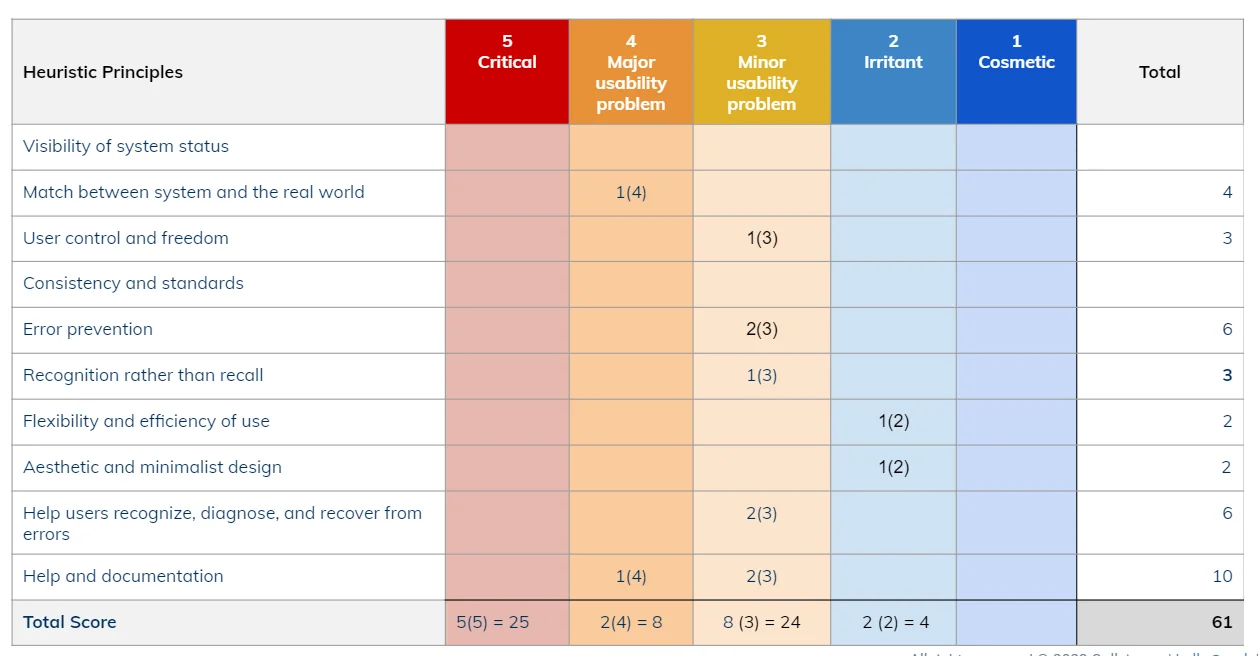
- Day 3 — score. Rate each step against the heuristics below. One number per step per heuristic.
- Day 4 — rank. Plot each finding on severity against effort. The top-left quadrant is your roadmap.
- Day 5 — write it up. Annotated screens, one finding per slide, with the recommendation attached to the evidence.
The ten heuristics to score against
- Visibility of system status — does the interface say what is happening?
- Match with the real world — does it use the user's words, not the company's?
- User control and freedom — can a mistake be undone?
- Consistency and standards — does the same thing look the same everywhere?
- Error prevention — is the mistake made impossible, or just reported?
- Recognition over recall — does it show options, or expect memory?
- Flexibility and efficiency — is there a fast path for the experienced?
- Aesthetic and minimal design — is anything on screen not earning its place?
- Error recovery — does it say what is wrong, where, and in words?
- Help and documentation — is help reachable at the point of confusion?
Score, do not describe
The difference between an audit that gets acted on and one that gets filed is the scoring. A written observation is an opinion a stakeholder can disagree with. A score across ten heuristics, applied identically to every step, produces a ranking — and a ranking is a plan.
On one storefront audit, scoring put product selection at the bottom of the table. The page was creating friction exactly where it needed to create confidence. Nobody argued, because the method had been applied to every other step the same way.
Rank by severity and effort, not by enthusiasm
| Severity | Meaning | Action |
|---|---|---|
| Critical | Blocks the task or loses money | Fix this sprint |
| Major | Causes avoidable drop-off | Fix this quarter |
| Minor | Friction, not failure | Batch with related work |
| Cosmetic | Inconsistency with no cost | Design system backlog |
What the deliverable should contain
One finding per page: the screenshot, the heuristic it violates, the severity, the recommendation, and the measure it should move. If a finding has no measure attached, it is a preference — label it as one and let the team decide.
Comments
Comments are not wired up yet. In the meantime, the conversation happens on LinkedIn — or write to hello@tagthose.in and we will reply.